Course
Give your AI a permanent memory of your business. A course for people who use ChatGPT or Claude daily.Compound Context

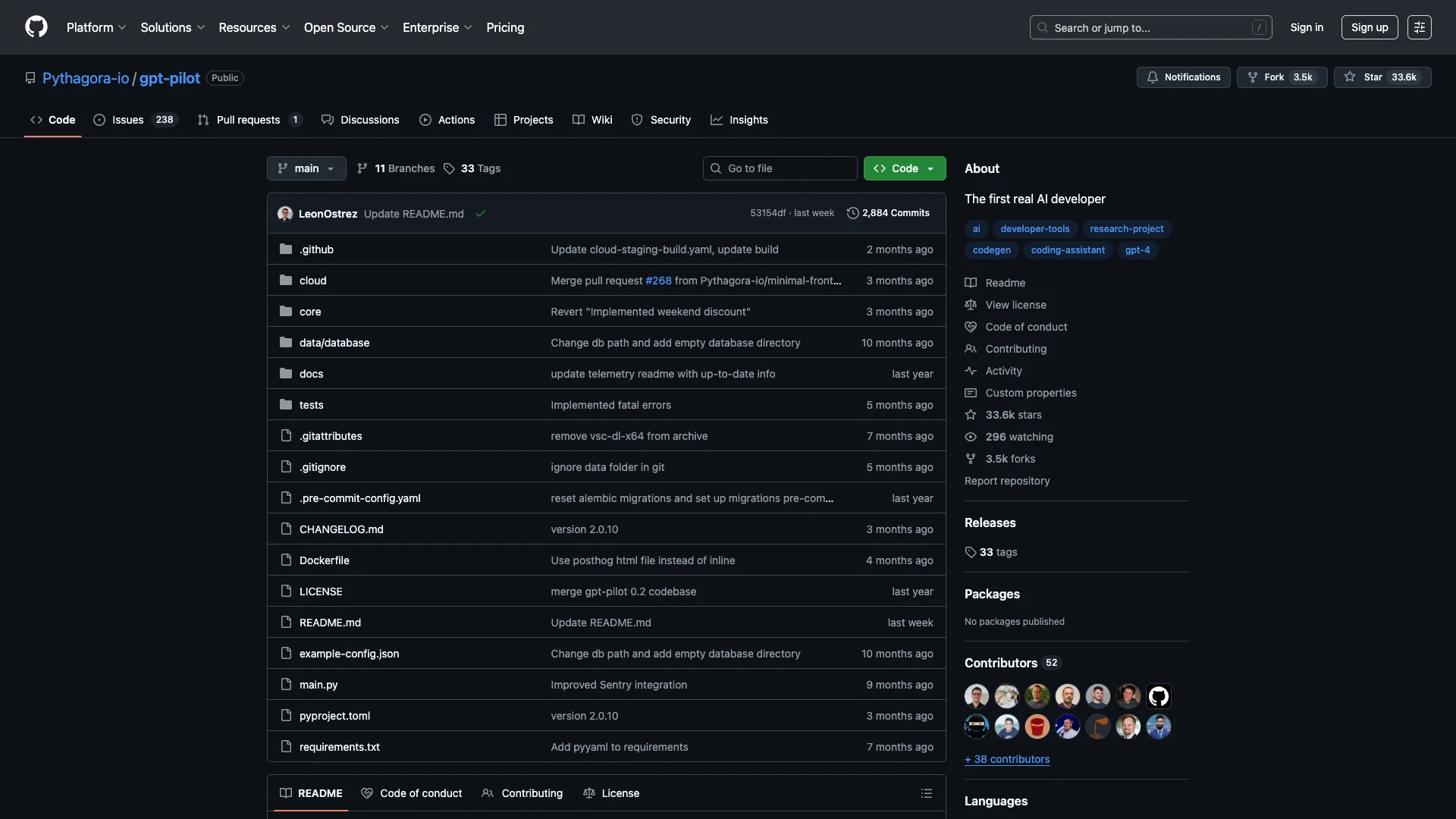
GPT Pilot is an AI tool that acts like a development team, creating full applications from your ideas. It works with you, writing code step-by-step and handling tasks like planning, coding, and debugging, while you oversee the process to ensure everything is just right.

Free Option

About gpt-pilot

Who It's For

This tool is for developers who want to build new applications faster. It's also for anyone interested in seeing how AI can help create complex software projects. You get to oversee the process and guide the AI. It's best for starting fresh projects, not for updating old codebases.

What You Get

You get a complete, working application built from your description. GPT Pilot handles all the steps, from planning the technology to writing the code and debugging it. It works like a team of AI experts who write most of the code, leaving you to fine-tune the final few details.

How It Works

You start by telling GPT Pilot what kind of app you want. Then, different AI "agents" take over, like a product owner, architect, and developer. They plan the app, choose technologies, write the code piece by piece, and even review their own work. If there's a problem, other agents help troubleshoot and fix bugs, always keeping you in the loop.
Stay in the loop

Weekly roundup of new AI agents. No spam, unsubscribe anytime.

Subscribe and get the free 2026 AI Agents Field Guide

Join 1,500+ AI builders · weekly, no spam

Features & Capabilities

🤖 Core AI Development Capabilities

Full Feature Generation

Writes complete application features based on provided descriptions, moving beyond simple code snippets.

Automated Debugging

Identifies and fixes code issues autonomously as they arise throughout the development process.

Multi-Agent System

Utilizes a sophisticated system of specialized AI agents (e.g., Architect, Developer, Reviewer) to manage various development stages.

🤝 Developer Workflow & Collaboration

Step-by-Step Development

Codes applications incrementally, mimicking a human developer's approach to facilitate real-time debugging and oversight.

Iterative Feature Extension

Enables developers to extend finished applications by adding new features through further instructions.

VS Code Integration

Offers a dedicated VS Code extension for a deeply integrated and seamless AI-assisted development experience.

⚙️ System Configuration & Scalability

LLM Provider Flexibility

Supports multiple Large Language Model providers, including OpenAI, Anthropic, and Groq, with Azure and OpenRouter compatibility.

Database Support

Provides built-in SQLite database support by default, with an option to configure PostgreSQL for more robust needs.

Scalable Context Management

Optimizes LLM context by filtering code to show only relevant parts, enabling efficient work on large-scale projects.

🗄️ Project Management & CLI

Project Listing & Resumption

Allows users to list all created projects and resume development from specific or latest steps via command-line interface.

Project Deletion

Provides a command-line option to permanently delete projects with a specified ID.

Use Cases

Accelerating Full-Stack Application Development

Developers often face time constraints when building new applications from scratch, requiring significant effort across various development stages. GPT Pilot acts as a complete AI development team, automating the process of clarifying requirements, architecting, coding, and reviewing, enabling rapid iteration and delivery of production-ready full-stack applications with human oversight.

Software DevelopmentFor: Software Developers

Streamlining AI-Assisted Debugging and Code Review

Traditional debugging and code review processes can be time-consuming and prone to human error, slowing down development cycles. GPT Pilot integrates a Debugger and Reviewer agent that works iteratively with the developer, identifying and fixing issues as they arise and ensuring code quality, making the debugging process more efficient and collaborative.

Software DevelopmentFor: Software Developers

Building Scalable and Customizable Software Solutions

Businesses require robust and scalable custom software, but developing such solutions typically involves extensive coding and architectural planning. GPT Pilot is designed to work at scale, showing only relevant code in context to the LLM, and being open-source, it allows developers to deeply customize agents and logic, facilitating the creation of complex, production-ready applications tailored to specific business needs.

Enterprise SoftwareFor: CTOs

AI-Driven Prototyping and Learning for Developers

Developers looking to rapidly prototype new ideas or learn about AI-driven development often face a steep learning curve and significant setup time. GPT Pilot offers a hands-on platform where developers can quickly describe an app idea and see it built step-by-step by AI agents, providing a practical way to experiment with new concepts and understand AI's role in the development workflow.

Software DevelopmentFor: Junior Developers

Frequently asked questions

GPT Pilot is an AI-powered development tool that automates the process of building full-stack applications. It uses multiple specialized AI agents to mimic the workflow of a real development team, guiding the creation of apps from initial concept to deployment.

GPT Pilot works by asking you to describe the app you want to build, using AI agents (like Product Owner, Architect, Developer, Code Monkey, Reviewer, etc.) to clarify requirements, plan architecture, break down tasks, write code, and review changes, and iteratively generating and reviewing code, with human oversight at key points.

The main AI agents in GPT Pilot include the Product Owner, who oversees the project (mostly symbolic); the Specification Writer, who clarifies and refines requirements; the Architect, who chooses technologies and checks installations; the Tech Lead, who breaks down development into tasks; the Developer, who plans implementation steps; the Code Monkey, who writes actual code; the Reviewer, who checks code quality and sends back for fixes; the Troubleshooter, who helps debug issues; the Debugger, who handles errors; and the Technical Writer, who creates documentation.

The easiest way to get started with GPT Pilot is to install the VS Code Extension or use the CLI Tool by cloning the repository, setting up a Python virtual environment, and running python main.py. You will also need Python 3.9+ and an API key from OpenAI, Anthropic, or a local LLM.

Yes. You can configure GPT Pilot to use your own OpenAI, Anthropic, or local LLM API keys. These are stored in a local config.json file for security.

API keys and sensitive data are stored locally, and the tool does not inherently encrypt application data, so security depends on your environment and practices. Users should always audit the generated code and follow their organization’s compliance standards.

Yes. GPT Pilot is open-source, so you can modify agents, add custom logic, integrate new tools or steps, and create new agents for specific tasks.

GPT Pilot is optimized for new projects. For existing codebases, you’ll need to manually onboard requirements, architecture, and schemas. There’s no automated import for legacy code or databases.

To handle errors and troubleshooting, users should review error logs in their terminal, check API keys and configuration, ensure dependencies (like Docker, PostgreSQL) are running, and consult the GitHub issues page or community forums for help.

GPT Pilot supports integrations with OpenAI, Anthropic, Groq for LLMs, Docker, and PostgreSQL.

GPT Pilot ensures code quality by having each step reviewed by the Reviewer agent, generating and running automated tests, and allowing human developers to intervene at any point to review, debug, or modify code.

GPT Pilot is open-source, but you’ll need your own API key (which may have usage costs depending on the provider).

More information and help can be found at the GitHub repository (https://github.com/Pythagora-io/gpt-pilot), community forums, GitHub issues for troubleshooting, and through documentation and templates for custom agent creation.

The limitations of GPT Pilot are that it is best for new projects, not legacy code migration, it requires human oversight especially for complex or ambiguous requirements, and initial prompts must be clear as errors early on can lead to significant issues later.

GPT Pilot stands out by using a multi-agent system to simulate a real development team, focusing on production-ready, full-stack applications, and allowing deep customization and integration.

Tags

Specifications

Deployment
Self-hosted
Browser
Target Audience
Individual
Startup
Complexity
Developer

Pricing

Free

Per monthly

Free
  • Unlimited public and private repositories
  • Dependabot security and version updates
  • 2,000 CI/CD minutes/month for Actions (Free for public repositories)
  • 500MB of Packages storage (Free for public repositories)
  • Issues and Projects
  • Community support
  • GitHub Codespaces ($0 spend limit)
  • Code reviews and Pull requests (including draft, multiple assignees)
  • Repository rules for public repositories
  • Code owners for public repositories
  • Repository insights
  • Team discussions and Organization/team management
  • Pages and Wikis for public repositories
  • Unlimited collaborators for public repositories
  • Unlimited collaborators for private repositories
  • Milestones
  • Multiple issue assignees

Team

Per monthly

$4
  • Includes all features from the Free plan
  • GitHub Codespaces (with policies and controls, usage billed)
  • Advanced Repository rules (enforce across organization, private repos)
  • Multiple and required reviewers for pull requests
  • Code owners and Draft pull requests (organization-wide, private repos)
  • Pages and Wikis (organization-wide, private repos)
  • Environment deployment branches and secrets
  • 3,000 CI/CD minutes/month for Actions (Free for public repositories)
  • 2GB of Packages storage (Free for public repositories)
  • Standard (web-based) Support
  • GitHub Secret Protection (includes Push protection, Secret scanning)
  • GitHub Code Security (includes Copilot Autofix, CodeQL, Dependabot rules)

Enterprise

Per monthly

$21
  • Includes all features from the Team plan
  • Data residency options
  • Enterprise Managed Users (EMU) and SCIM provisioning
  • Centralized Enterprise Account management
  • Environment protection rules
  • Advanced enterprise-wide Repository rules (with rule insights)
  • Audit Log API and Advanced auditing
  • SOC1, SOC2, type 2 reports annually
  • FedRAMP Tailored Authority to Operate (ATO)
  • SAML single sign-on (SSO)
  • GitHub Connect
  • 50,000 CI/CD minutes/month for Actions (Free for public repositories)
  • 50GB of Packages storage (Free for public repositories)
  • IP allow list
  • Role-based access control
  • Required 2FA

✓ Free trial • ✓ Free plan • ✓ Plans from $4 / monthly • ✓ Enterprise options

Integrations

GitHub
VS Code
Python
Docker
PostgreSQL
OpenAI

Want your AI tool listed here?

Start with a free eligibility check.

Submit