Course
Give your AI a permanent memory of your business. A course for people who use ChatGPT or Claude daily.Compound Context
cobl logo

cobl

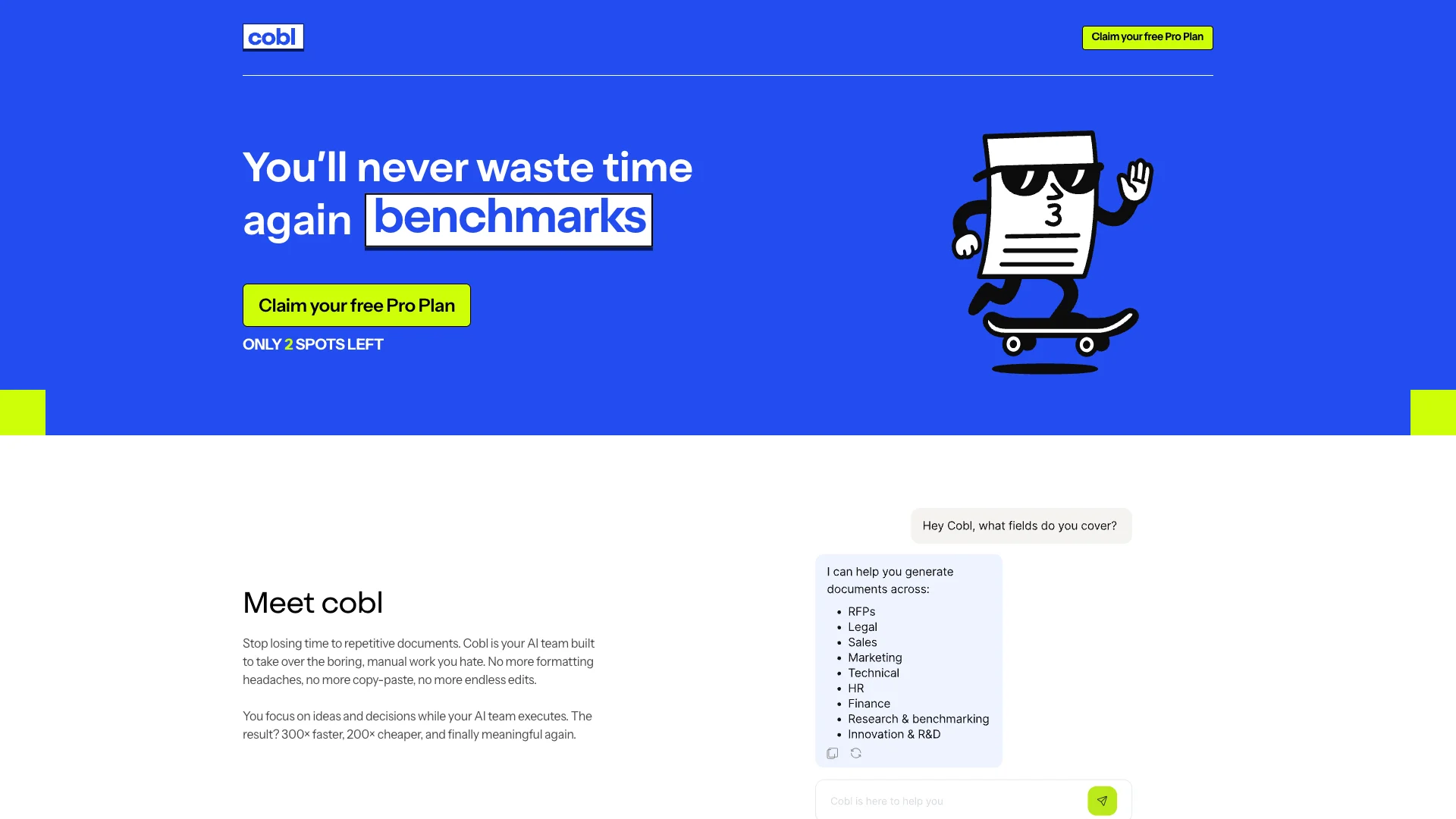
Cobl is an AI team designed to automate repetitive document tasks and complex analysis, like creating proposals or understanding old code. It frees you from boring, manual work, allowing you to focus on important decisions and creativity, while getting results much faster and cheaper.

About cobl

Who It's For

This tool is for anyone spending too much time on repetitive documents like proposals, applications, or technical reports. It also helps those dealing with complex legacy code, such as COBOL, needing analysis or documentation. Cobl lets you focus on high-value tasks, not tedious paperwork.

What You Get

You get an AI team that automates tiresome document creation and analysis, resulting in faster, cheaper outputs with significantly less manual effort. It's fully customizable, scalable for any document size, and can extract vital business logic from systems like COBOL code.

How It Works

Cobl uses specialized AI agents that collaborate to handle tasks from data extraction to polishing. You can preview, tweak, and regenerate outputs by chatting with the AI, ensuring you always control the final, high-quality document.
Stay in the loop

Weekly roundup of new AI agents. No spam, unsubscribe anytime.

Subscribe and get the free 2026 AI Agents Field Guide

Join 1,500+ AI builders · weekly, no spam

Features & Capabilities

⚙️ Core Document Automation

Automated Document Generation

AI agents handle end-to-end document creation, formatting, and rework, significantly reducing manual effort.

Scalable Output Consistency

A block-based graph system ensures consistent quality for documents of any length, from memos to large reports.

Customizable Templates

Mirror real-life documents with reusable templates, ensuring brand and content consistency.

🧠 Intelligent AI Orchestration

Multi-Agent Task Assignment

Assign specialized AI agents for distinct tasks like data extraction, drafting, and polishing, enabling coordinated workflows.

Sophisticated AI Chains

Agents build on each other's outputs, iteratively improving document quality with each processing step.

Human-in-the-Loop Control

Preview, tweak, and regenerate document outputs via an interactive chat interface, maintaining user control.

Use Cases

Automating Legacy COBOL System Documentation

Enterprises struggle with outdated or non-existent documentation for critical COBOL systems, hindering maintenance and modernization. Cobl's AI agents automatically analyze COBOL code to extract business rules, process workflows, and tribal knowledge. This generates comprehensive technical documents, specifications, pseudocode, and flowcharts to provide a clear understanding of complex systems.

Financial Services, Government, Large EnterprisesFor: IT Architects, Legacy System Engineers, Business Analysts, Compliance Officers

AI-Powered Business Logic Extraction for Modernization

Modernizing legacy COBOL applications often requires painstakingly manual extraction and translation of business logic, leading to delays and errors. Cobl's AI accelerates business rule discovery by up to 60%, extracting decision trees, calculation rules, and validation rules from COBOL code. It delivers these as refactored COBOL, translated Java/C code, or detailed specifications for seamless migration.

Financial Services, Government, Enterprise ITFor: Software Developers, System Architects, Modernization Project Managers

Streamlining High-Stakes Business Document Creation

Sales, R&D, and administrative teams often lose weeks to repetitive and complex document tasks like creating RFP responses, sales proposals, and grant applications, diverting focus from strategic work. Cobl's multi-agent AI system automates the end-to-end process of drafting, data extraction, and polishing these documents. This cuts manual effort by 90% and enables faster, cheaper, and more consistent output.

B2B SaaS, Professional Services, Research & DevelopmentFor: Account Executives, Proposal Managers, Grant Writers, Sales Operations Teams

Frequently asked questions

Modern AI platforms achieve 85-95% accuracy in documentation generation. The highest accuracy applies to well-structured code, while lower accuracy may occur with legacy systems that have poor commenting and documentation.

Yes, AI can identify business rules embedded in COBOL logic through pattern recognition and semantic analysis, even from poorly documented code. However, expert validation is recommended for critical business rules.

AI algorithms can identify and extract multiple types of information from COBOL code, including Decision Trees for complex conditional logic mapped to business decision structures, Calculation Rules for mathematical formulas and business calculations, Validation Rules for data validation and business constraint identification, and Process Workflows for sequential business process identification and mapping.

AI-enhanced pattern recognition can accelerate business rule discovery by up to 60%. These algorithms identify hidden patterns, complex dependencies, and business logic relationships that manual analysis alone might miss.

Yes, organizations can choose to start with critical calculations or specific business functions. Extracted logic can be delivered for just the parts needed, allowing phased approaches to transformation.

AI systems can capture tribal knowledge through multiple methods, including Code Comment Analysis for extraction and categorization of developer comments, Historical Change Analysis for understanding system evolution through version control history, Error Pattern Analysis for learning from historical issues and resolutions, and Performance Pattern Analysis for identification of performance-critical code sections.

Extracted business logic is delivered in multiple formats such as refactored COBOL code, translated Java or C code, comprehensive documentation and specifications, pseudocode and flowcharts, and test cases with validation data.

AI techniques can profile COBOL applications and identify inefficiencies. Machine learning models analyze logs and execution traces to detect inefficient loops, frequent I/O operations, or unnecessary computations. AI can also recommend alternative algorithms or data structures to improve throughput.

Production systems are never touched during the extraction process. Automated analysis tools combined with business domain expertise identify critical versus non-critical code paths, allowing teams to prioritize modernization efforts where they'll have the most impact.

AI-powered COBOL modernization supports all major cloud platforms including AWS, Microsoft Azure, Google Cloud Platform, and IBM Cloud. The approach focuses on business logic extraction, making modernized systems cloud-agnostic and portable between platforms.

Successful AI implementation requires a structured phased approach, consisting of Phase 1: Assessment and Planning, which includes codebase analysis, tool evaluation, pilot project selection, and success metrics definition, and Phase 2: Pilot Implementation, which covers tool configuration, initial analysis, validation and refinement, and process integration.

It's critical to establish a complete understanding of the system's architecture and internal logic. This involves identifying key components such as input/output routines, business rule implementations, database interactions, and system dependencies. Use static analysis tools to examine source code structure and dynamic analysis tools to monitor runtime behavior.

Tags