Course
Give your AI a permanent memory of your business. A course for people who use ChatGPT or Claude daily.Compound Context
LiveKit Agents logo

LiveKit Agents

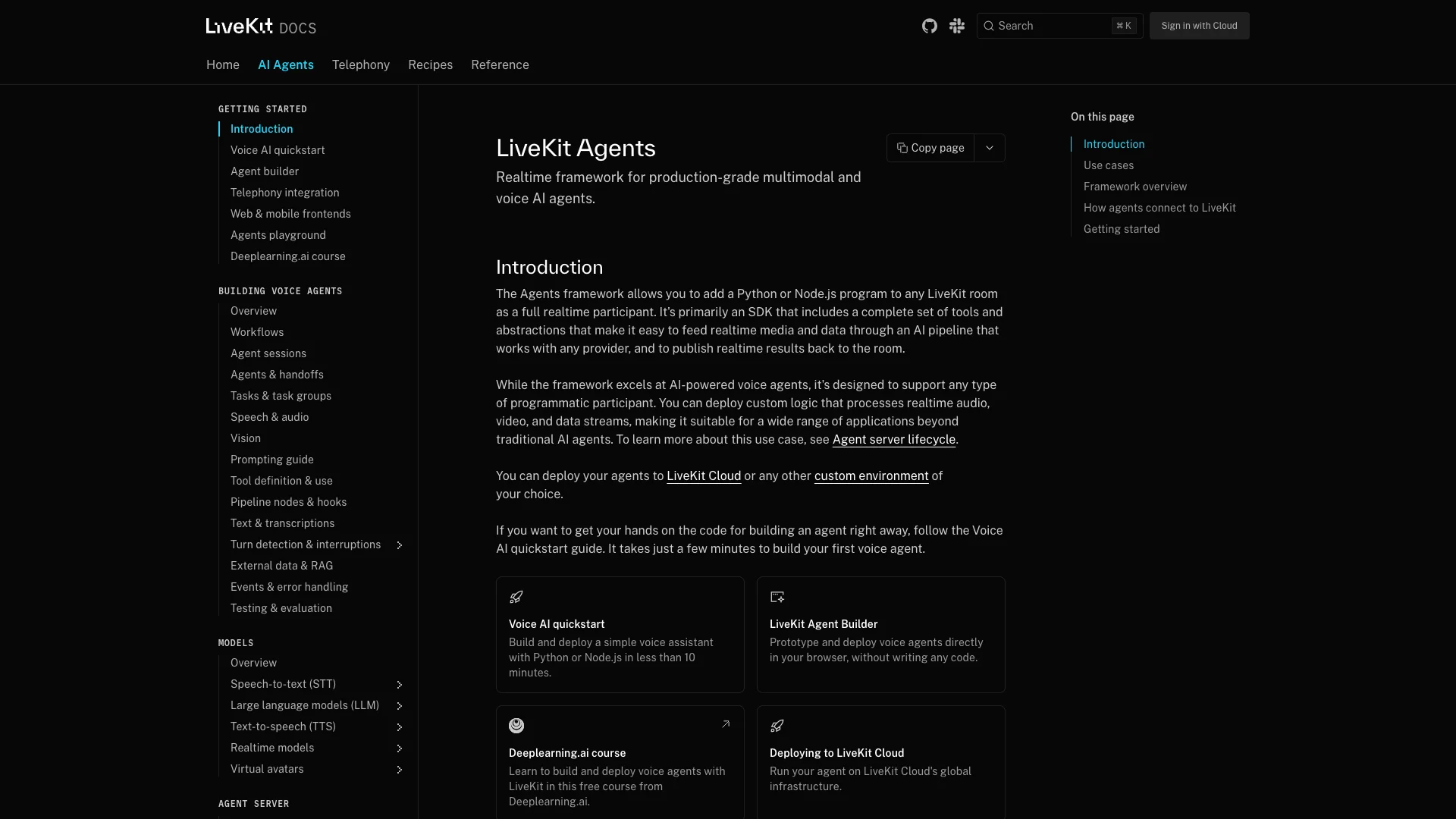
LiveKit Agents helps you create AI assistants that join live calls and chats. These smart agents can process voice, video, and text in real-time, letting them talk, understand, and respond instantly. It's great for customer service, virtual helpers, and more.

About LiveKit Agents

Who It's For

LiveKit Agents is for developers building AI into live apps. It creates smart agents for customer service, virtual healthcare, or instant translation. If you need AI that talks, listens, or sees in real-time, this tool helps.

What You Get

You get tools to build AI processing live voice, video, and text. Agents can understand conversations, use many AI models, and respond instantly. It offers natural turn detection and multi-agent task sharing. It's ready for production use.

How It Works

Your AI agent, using Python or Node.js, joins a LiveKit room. It uses WebRTC for live audio, video, and text. The agent processes data with AI and sends responses. Deploy it on LiveKit Cloud or your own servers. Phone calls are supported.
Stay in the loop

Weekly roundup of new AI agents. No spam, unsubscribe anytime.

Subscribe and get the free 2026 AI Agents Field Guide

Join 1,500+ AI builders · weekly, no spam

Features & Capabilities

⚙️ Core Agent Framework

Programmable Participants

Add Python or Node.js programs as full realtime participants to any LiveKit room.

Multimodal Stream Processing

Process realtime audio, video, and data streams within the agent.

AI Pipeline Framework

Provides an SDK with tools and abstractions for building AI pipelines with any provider.

Flexible Deployment

Deploy agents to LiveKit Cloud or custom environments of your choice.

🗣️ Realtime Voice & Multimodal AI

Voice AI Pipeline Management

Handles core challenges of realtime voice AI, including STT-LLM-TTS streaming and interruptions.

Advanced Turn Detection

Utilizes a custom turn detection model for lifelike conversational flow.

Multimodal Input/Output

Build agents that can process and produce output in voice, video, and text modalities.

LLM Tool Use

Define and leverage tools compatible with any Large Language Model.

🔗 Integration & Extensibility

Broad AI Provider Integrations

Integrate with major AI providers for LLMs, STT, TTS, and more via a plugin system.

Multi-Agent Handoff

Break down complex workflows by enabling handoff between multiple agents.

WebRTC Communication

Ensures smooth, reliable communication between agents and users over varying network conditions.

Telephony Integration

Allows users to join agent calls from a phone, complementing frontend app communication.

✨ Production & Developer Experience

Production-Grade Orchestration

Includes built-in worker orchestration, load balancing, and Kubernetes compatibility.

Code-Centric Development

Empowers developers to build agents primarily through code, not just configuration.

Open Source Framework

The entire framework and LiveKit ecosystem are open source under the Apache 2.0 license.

Worker-Job Architecture

Utilizes a worker-job model for managing agent processes and dispatches within a LiveKit server.

Use Cases

Automating and Augmenting Customer Service Interactions

Businesses face challenges with scaling customer support, handling routine inquiries efficiently, and providing 24/7 availability. LiveKit Agents enable the deployment of AI-powered virtual assistants that can manage inbound/outbound calls, engage in multimodal conversations (voice, text, video), resolve common issues, and seamlessly hand off complex cases to human agents with full context, significantly improving operational efficiency and customer satisfaction.

Customer Service, BPO, TelecommunicationsFor: Customer Service Managers, Call Center Supervisors, Support Engineers

Facilitating Real-time Multilingual Voice and Text Conversations

Global operations and diverse customer bases often encounter communication barriers due to different languages. LiveKit Agents can be used to build real-time translation assistants that participate in LiveKit rooms, instantly translating spoken and textual conversations between participants, ensuring smooth and effective communication across language divides in business meetings, support calls, or educational settings.

Global Business, Education, Healthcare, TelecommunicationsFor: International Teams, Global Sales & Support, Educators, Conference Organizers

Integrating AI for Real-time Telehealth Consultations

As telehealth adoption grows, there's a need for scalable, intelligent assistance to streamline patient interactions and support medical professionals. LiveKit Agents enable the creation of AI participants for telemedicine consultations that can handle patient intake, answer FAQs, provide preliminary information, or even act as an assistant during a consultation, improving efficiency and accessibility in healthcare delivery.

Healthcare, TelemedicineFor: Telehealth Platform Developers, Healthcare Administrators, Medical Practitioners

Streamlining Sales Engagement and Lead Qualification with AI

Sales teams often spend significant time on initial lead qualification and routine inquiries, delaying engagement with high-potential prospects. LiveKit Agents allows for the deployment of intelligent AI sales assistants that can engage prospects through voice or text, qualify leads, answer product questions, and, critically, leverage multi-agent handoff capabilities to transfer conversations seamlessly to specialized AI agents (e.g., for pricing) or human sales reps, maintaining context and accelerating the sales cycle.

B2B SaaS, Sales & Marketing, Lead GenerationFor: Sales Development Teams, Account Executives, Go-to-Market Leaders

Frequently asked questions

LiveKit Agents is an open-source framework that lets you add programmable AI participants—such as voice, video, and text agents—to LiveKit rooms in real time. It supports building AI voice agents, multi-agent systems, and any programmatic participant with real-time audio, video, and data processing capabilities.

You can build LiveKit agents using Python or Node.js.

Agents register as "worker" processes with a LiveKit server (self-hosted or LiveKit Cloud). When dispatched, a worker boots a "job" subprocess that joins the LiveKit room as a full participant, enabling real-time interaction.

The LiveKit Agents framework supports multiple input/output modes including voice, video, and text. It features streaming pipelines for speech-to-text (STT), large language models (LLM), and text-to-speech (TTS) with interruption and turn detection handling. It also provides flexible multi-agent handoffs and workflows for complex task delegation, supports tools integration callable by any LLM, and offers wide AI provider integrations for STT, LLM, TTS, and more. Additional features include telephony and WebRTC client support for making or receiving calls from phones, semantic turn detection using transformers to avoid interruptions, and session and context data management for smooth conversation state retention.

Agents can handle different parts of a conversation and transfer control smoothly between one another, maintaining context and session metadata so conversations flow naturally. For example, a Sales Agent can transfer to a Technical Specialist or Pricing Agent based on user needs.

An AgentSession orchestrates user input, voice pipelines, LLM invocation, and output. Each session contains one or more Agent components managing AI logic and tools. You configure voice providers and interaction patterns globally or per agent.

Yes, you can deploy agents to LiveKit Cloud using the LiveKit CLI or run them on any custom environment. Agents register with the server and can be scaled via worker dispatch APIs.

No, they reduce repetitive workload and automate routine tasks but are designed to escalate or hand off complex conversations to humans while preserving context.

Agents can support any language available in your STT, LLM, and TTS stacks. Voice output leverages TTS providers and can be tuned for naturalness depending on provider capabilities.

Yes, LiveKit Agents support defining custom tools callable by the LLM. These tools can generate speech, call frontend methods, handle handoffs, external API calls, and data retrieval for enhanced interactivity.

LiveKit provides a Python Voice AI quickstart guide that walks you through building your first voice agent in under 10 minutes.

Yes, LiveKit Agents integrate with LiveKit’s telephony stack, enabling agents to receive or make phone calls seamlessly.

Tags

Specifications

Deployment
API
Self-hosted
Cloud
Target Audience
Startup
Business
Enterprise
Complexity
Developer

Integrations

Python
Node.js
Kubernetes

Want your AI tool listed here?

Start with a free eligibility check.

Submit