Course
Give your AI a permanent memory of your business. A course for people who use ChatGPT or Claude daily.Compound Context
Consensus logo

Consensus

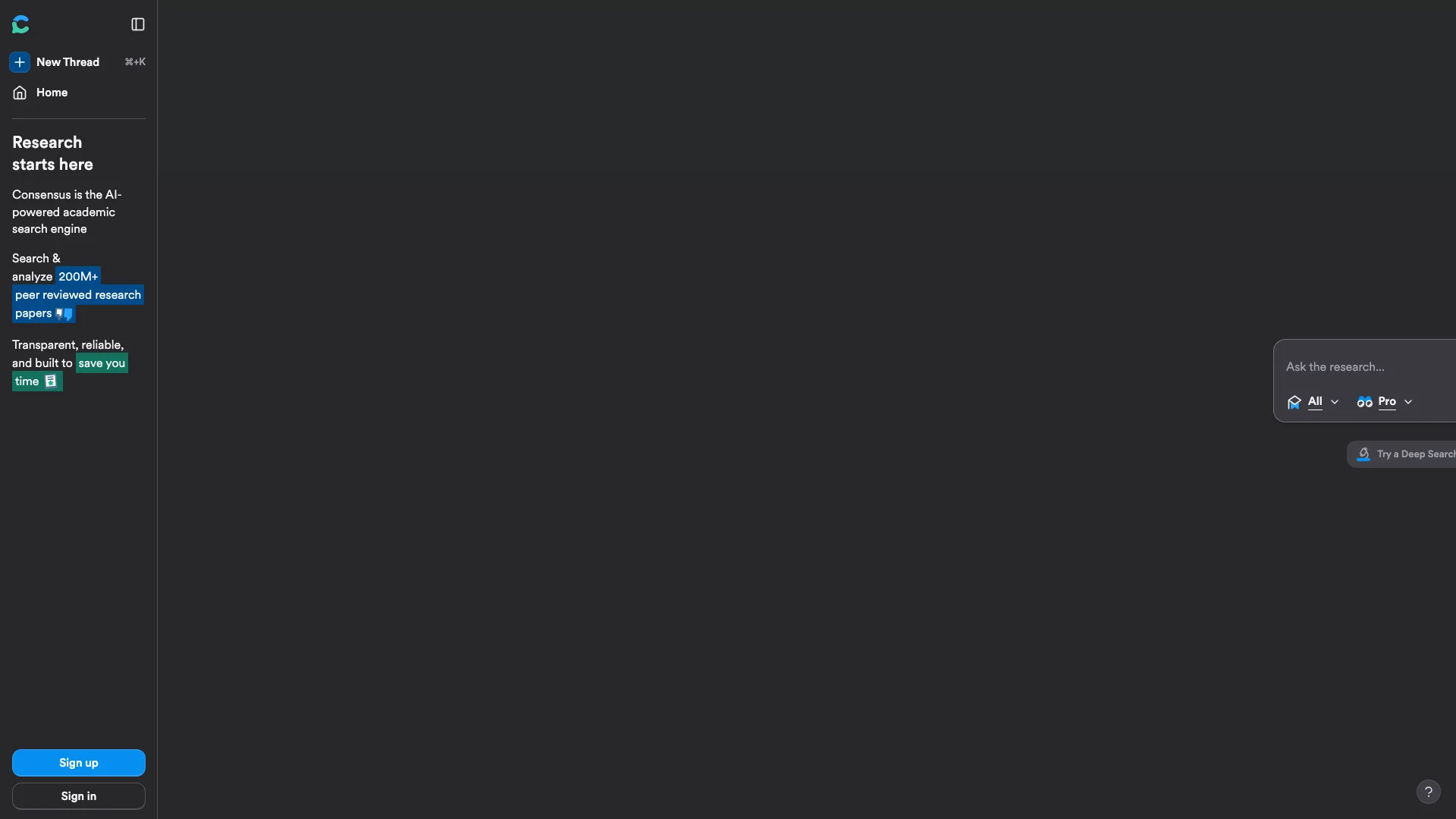
Consensus AI is an intelligent search engine that quickly finds and summarizes information from over 200 million academic research papers. It uses AI to analyze findings, giving you clear, reliable answers with citations, which saves time for students, researchers, and clinicians.

About Consensus

Who It's For

This tool is for anyone needing to understand academic research quickly. It's perfect for students, researchers, and medical professionals. If you need reliable information grounded in studies, this tool helps you find it fast.

What You Get

You get clear summaries from over 200 million peer-reviewed papers. The tool provides a "Consensus Meter" to show how much researchers agree. You can filter results, get key details from papers, and even chat with individual papers to ask specific questions. All answers include citations to check the original source.

How It Works

You simply type your research question, keywords, or a paper title. The AI searches its vast database of scientific articles. It reads and analyzes the most relevant papers. Finally, it gives you a simple summary of the findings, backed by real, citable research.
Stay in the loop

Weekly roundup of new AI agents. No spam, unsubscribe anytime.

Subscribe and get the free 2026 AI Agents Field Guide

Join 1,500+ AI builders · weekly, no spam

Features & Capabilities

🔍 AI-Powered Research Search

AI Academic Search

Utilizes AI to power a specialized search engine for academic papers.

Extensive Research Database

Provides access to over 200 million peer-reviewed research papers.

Deep Search Capabilities

Enables advanced and precise searches within the academic database.

📝 AI-Assisted Research Tools

Research Outline Drafting

Assists users in generating structured outlines for their research projects.

Comparative Table Generation

Automatically creates tables to compare various factors or datasets from research.

Consensus Meter

Measures and highlights the level of consensus within research findings on a topic.

Use Cases

Accelerating Academic Literature Reviews

Students and researchers typically spend extensive time sifting through and synthesizing academic literature for projects like dissertations or reviews. Consensus AI significantly speeds up this process by summarizing key findings from millions of peer-reviewed papers, identifying study designs, and providing a quantified scientific consensus on specific research questions.

Academia, Scientific ResearchFor: PhD Candidates, University Researchers, Graduate Students

Informing Professional Decisions with Evidence-Based Research

Professionals across various sectors need quick, reliable access to the latest scientific evidence to support critical decisions and maintain industry relevance. Consensus AI empowers them to efficiently find, analyze, and synthesize peer-reviewed research across diverse fields, delivering citable insights and comparative analyses without requiring extensive academic search expertise.

Healthcare, Pharma & Biotech, Environmental Consulting, Business, Public PolicyFor: Clinicians, R&D Scientists, Policy Analysts, Business Strategists

Efficient Exploration of New Research Topics

When embarking on new projects or delving into unfamiliar academic domains, individuals need to rapidly build foundational knowledge and identify promising research avenues. Consensus AI facilitates this by enabling natural language queries across a vast scientific database, generating structured outputs like outlines or tables, and supporting follow-up questions for comprehensive topic exploration.

Academia, Technology, EducationFor: Students, Early-Career Researchers, Educators, Project Managers

In-Depth Analysis of Specific Research Papers

Researchers and students often need to meticulously analyze individual research papers or personal PDF documents to extract precise data, verify methodologies, or gain deeper insights. Consensus AI addresses this challenge by allowing users to directly chat with the full text of a paper or uploaded PDFs, efficiently extracting key details and answering specific questions without manual, laborious reading.

Academia, Scientific Research, PublishingFor: Researchers, PhD Candidates, Medical Residents, Grant Writers

Frequently asked questions

Consensus AI is an AI-powered search engine designed specifically for academic and scientific research. It searches over 200 million peer-reviewed research papers and uses artificial intelligence to summarize, analyze, and synthesize findings from the literature. Unlike general chatbots, Consensus AI grounds every answer in real, citable research papers.

When you enter a question, Consensus AI searches its database of academic papers using a hybrid approach: semantic search (AI embeddings) and keyword search (BM25). It identifies the most relevant papers based on your query. AI models (including commercial models like OpenAI and fine-tuned open-source models) analyze the papers. Finally, Consensus AI generates a clear summary of the findings, including citations so you can trace each insight back to the original source.

You can ask Yes/No questions, for example, “Does intermittent fasting improve cognitive performance?” You can also ask Relationship questions, for example, “What is the impact of climate change on GDP?” Additionally, keywords, phrases, or natural language questions like “mindfulness and blood pressure” are accepted, as are specific paper titles or author names.

The main features of Consensus AI include Pro Analysis, which summarizes key findings from the top papers and provides a high-level synthesis with citations. It also offers a Consensus Meter, visualizing the level of agreement or disagreement in the literature for yes/no questions, and Advanced Search Filters, allowing you to refine your search by publication year, study methodology, field of study, and journal rank. Other features are Study Snapshot, which extracts key details like methodology, sample size, and outcomes from each paper; Ask Paper, where you can chat directly with the full text of a paper for in-depth answers; Research Hub, to upload and chat with PDFs of papers; and Threads, for asking follow-up questions within the same search while maintaining context for deeper exploration.

You should use keywords, phrases, or natural language questions for your search query. For yes/no questions, you will receive a Consensus Meter showing agreement or disagreement. You can also use conversational prompts to customize the output, such as “create a table,” “make a bulleted list,” or “explain it like I’m 6.”

Yes. Consensus AI does not use your search data to train its AI models, and it does not share your data with third parties. Search data is anonymized and kept private.

Consensus AI is primarily focused on academic and scientific topics. It may not provide answers to general interest or lifestyle questions.

To get started with Consensus AI, first go to the official Consensus AI website. Then, sign up for a free account or use an institutional license if available. Next, enter your research question or keywords in the search bar. Finally, view the summarized results, citations, and use advanced features as needed.

The limitations of Consensus AI include potentially missing newly published or highly niche papers. Additionally, the results are a snapshot of relevant research findings, not a final truth. Vague or overly broad questions may also produce less valuable results.

Consensus AI offers a free account with limited features, such as 25 “Pro Searches” per month. Additional features and higher usage limits may require a paid subscription or institutional access.

Yes, you can read, analyze, and save your results for later use.

Consensus AI’s database is built on the Semantic Scholar dataset, which includes over 200 million peer-reviewed documents.

No. Consensus AI is a tool to help you quickly review and synthesize literature, but it is not a substitute for comprehensive searches in library databases.

Yes. Consensus AI is particularly useful for literature reviews, as it can quickly summarize findings, provide citations, and offer a consensus view of the literature.

Every response is tied back to real research papers and is grounded in scientific research. The platform uses both semantic and keyword search methods to ensure relevance and accuracy.

Consensus AI uses commercial models like OpenAI for general-purpose summarization and fine-tuned open-source models for domain-specific features, such as the Consensus Meter.

Yes. Using the “Threads” feature, you can ask follow-up questions within the same search, and Consensus AI will keep your context for deeper exploration.

Visit the Consensus Help Center for detailed guides, FAQs, and support.

Tags