Course
Give your AI a permanent memory of your business. A course for people who use ChatGPT or Claude daily.Compound Context
AgentOS logo

AgentOS

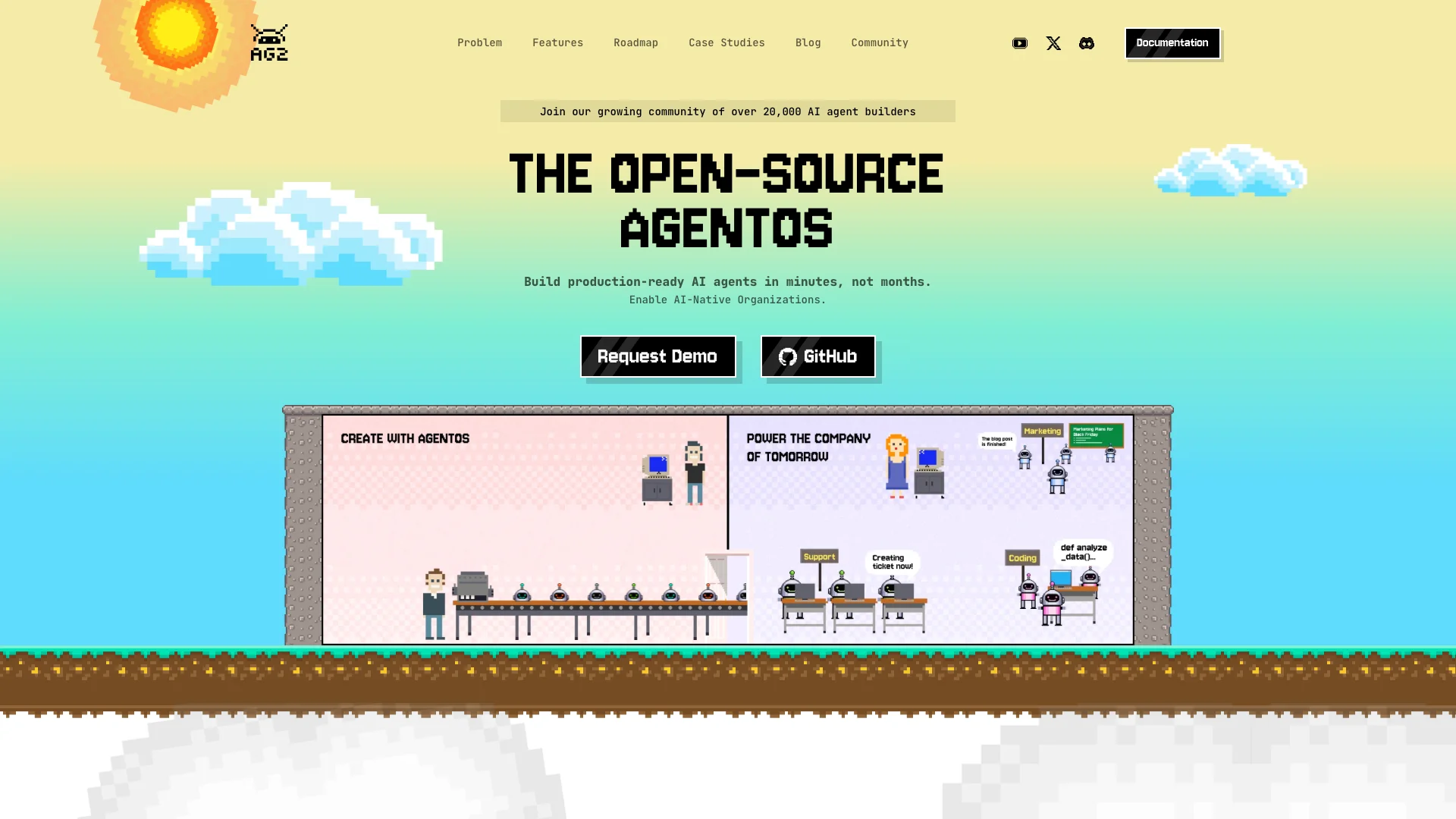
AG2 (AgentOS) is a system for quickly building and managing smart AI agents that work together. It lets you create specialized AIs for different tasks like problem-solving, taking action, or validating work. This makes it much faster to develop powerful, collaborative AI systems, seamlessly integrating human input.

About AgentOS

Who It's For

This tool is for anyone building advanced AI systems, from individual creators to big companies. If you want to make AI teammates that collaborate and improve how your organization works, AG2 (AgentOS) is for you. It helps both solo developers and enterprise teams.

What You Get

You get a simple way to build specialized AI agents that talk and work together. These agents can solve problems, take actions, check work, and manage group discussions. It also includes features for people to give input, approve actions, or step in when needed.

How It Works

AG2 (AgentOS) acts like an operating system for your AI agents. You define each agent's job, its tools, and instructions. The system then automatically manages how agents communicate, their conversations, and ensures they work together. This makes creating complex AI systems much easier and faster.
Stay in the loop

Weekly roundup of new AI agents. No spam, unsubscribe anytime.

Subscribe and get the free 2026 AI Agents Field Guide

Join 1,500+ AI builders · weekly, no spam

Features & Capabilities

🤖 Agent Design & Specialization

Assistant Agents

Agents designed for problem-solving tasks.

Executor Agents

Agents capable of performing actions.

Critic Agents

Agents focused on validating outputs and decisions.

Group Chat Managers

Agents that coordinate discussions within group chats.

🗣️ Agent Orchestration & Communication

Automated Coordination

Handles message routing, state management, and conversation flow automatically.

Dynamic Group Chats

Manages multi-agent discussions with flexible speaker turns.

Sequential Conversations

Enables agents to maintain context across ongoing discussions.

Nested Conversations

Allows for modular and hierarchical conversation structures.

🤝 Human-in-the-Loop Integration

Configurable Human Input

Provides various methods for humans to provide input and oversight.

Flexible Intervention Points

Allows humans to intervene at specific stages of agent workflows.

Human Approval Workflows

Includes optional steps for human review and approval.

Context-Aware Handoff

Facilitates smooth transitions to human agents with full conversation context.

Use Cases

Automating Multi-Stage Business Workflows with Intelligent Agent Teams

Businesses struggle to automate complex, multi-step processes that require specialized tasks and coordination. AG2 enables organizations to define and orchestrate networks of specialized AI agents (e.g., Assistant, Executor, Critic) that collaborate, manage conversation flow, and integrate human oversight, transforming work and boosting operational efficiency.

General Business AutomationFor: Business Process Owners

Accelerating Spec-Driven AI Software Development with AgentOS

Software development teams face challenges in rapidly translating product specifications into high-quality code and maintaining coding standards. AgentOS provides a multi-agent system with a 3-layer context (Standards, Product, Specs) that integrates with AI coding tools, allowing specialized agents to assist with problem-solving, code execution, and validation, thereby streamlining development cycles.

Software DevelopmentFor: Software Engineers

Deploying Scalable and Precise Customer and Business Automation Agents

Organizations need AI solutions that offer both precision and scalability for tasks like customer support or internal business automation, often limited by single-model AI systems. AgentOS enables the creation of specialized, interconnected agents that provide increased accuracy, handle complex interactions, and can be easily configured via no-code interfaces or deployed through widgets/APIs for various customer-facing or internal applications.

Customer ServiceFor: CX Leaders

Rapid Prototyping and Deployment of Next-Gen AI Products

Solo founders and enterprise innovation teams need tools to quickly prototype and deploy sophisticated AI products that leverage multi-agent architectures. AG2 offers flexible agent construction, orchestration, and seamless human integration, allowing users to build production-ready AI agents and networks efficiently, making advanced AI development accessible and accelerating time-to-market for new solutions.

AI Product DevelopmentFor: AI Product Managers

Frequently asked questions

AgentOS is a specialized operating system designed to coordinate and orchestrate interactions between multiple specialized AI agents. Unlike traditional AI assistants that attempt to answer all questions with a single model, AgentOS adopts a distributed, multi-agent architecture that provides increased precision through agent specialization and better scalability since each agent can be improved independently. There are multiple implementations of AgentOS available, including platforms focused on customer service and business automation, as well as spec-driven development systems for AI coding agents.

An agent consists of three fundamental components: a Model (the LLM powering the agent's reasoning), Tools (external functions or APIs the agent can use to take action), and Instructions (explicit guidelines and guardrails defining how the agent should behave).

Traditional AI assistants attempt to answer all questions with a single model, which limits precision and scalability. AgentOS uses a distributed approach where multiple specialized agents work together, overcoming the limitations of single-model systems and enabling handling of more complex scenarios with superior collective intelligence.

For spec-driven development implementations, AgentOS uses a 3-layer context system consisting of: Standards (how you build, including your coding standards), Product (what you're building and why, including vision and roadmap), and Specs (what you're building next, with specific features and implementation details).

On platforms like Swiftask, AgentOS agents can be created through a no-code interface that allows selection of underlying AI models (OpenAI, Claude, Mistral), definition of custom instructions, and attachment of specific knowledge bases. This democratizes access to the technology, allowing even users without technical skills to deploy sophisticated agents.

Customization is extensive and includes adjusting the appearance of agents (avatar, colors, welcome messages) and more technical parameters like human intervention points or approval workflows. This flexibility allows precise adaptation of agent behavior to specific use case needs.

Deployment options include widgets that can be integrated into any website or intranet for simpler use cases, and a complete API for more advanced needs that allows deep integration with existing systems. This dual approach guarantees smooth adoption whether for simple or complex technical implementations.

AgentOS adapts to preferred AI coding tools through flexible configuration options. It works with Claude Code and other tools like Cursor, Codex, Gemini, and Windsurf. AgentOS commands can be used sequentially in any AI coding tool.

AgentOS enables creation of different specialized agent types including Assistant agents for problem-solving, Executor agents for taking action, Critic agents for validation, and Group chat managers for coordination.

AgentOS handles message routing, state management, and conversation flow automatically. It supports two-agent conversations, group chats with dynamic speaker selection, sequential chats with context carryover, and nested conversations for modularity.

AgentOS seamlessly integrates human oversight and input into agent workflows through configurable human input modes, flexible intervention points, optional human approval workflows, interactive conversation interfaces, and context-aware human handoff capabilities.

High-quality instructions are essential for agents. Best practices include using existing operating procedures, support scripts, or policy documents to create LLM-friendly instructions that reduce ambiguity and improve agent decision-making, resulting in smoother workflow execution and fewer errors.

AI agents should analyze their outputs, detect errors, and adjust based on feedback loops—whether from human intervention or automated correction mechanisms. This allows agents to learn from their own mistakes and improve over time.

The recommended range is 4-6 tools. Too many tools can lead to confusion, slower response times, and degraded AI performance.

Tags