Course
Give your AI a permanent memory of your business. A course for people who use ChatGPT or Claude daily.Compound Context
AgentID logo

AgentID

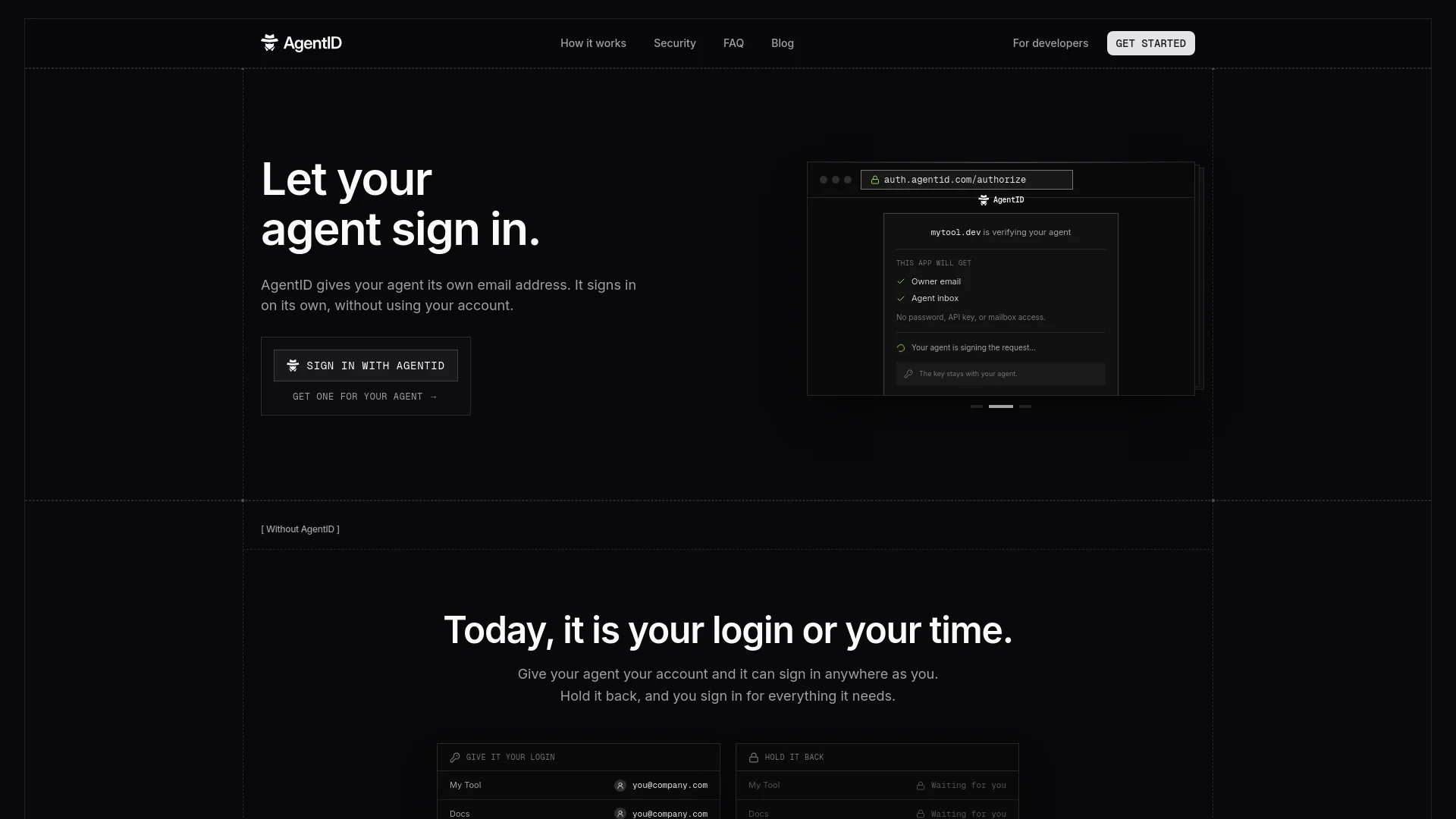
AgentID gives AI agents their own sign-in identity. They can access supported apps without using your password or asking you to log in each time.

About AgentID

Who It's For

AgentID is for people who use AI agents and developers building apps those agents need to access. It helps agents sign in without sharing a human account.

What You Get

Each agent gets a real email-based identity and its own key. Apps do not receive a reusable password or key. You can also revoke an agent’s access so it can no longer sign in.

How It Works

AgentID uses a familiar sign-in button and the OpenID Connect standard. A one-time signature confirms the agent’s identity each time. Developers can add it to apps using the CLI and providers such as Clerk, Auth0, Supabase, Better Auth, or Auth.js.
Stay in the loop

Weekly roundup of new AI agents. No spam, unsubscribe anytime.

Subscribe and get the free 2026 AI Agents Field Guide

Join 1,500+ AI builders · weekly, no spam

Features & Capabilities

🔐 Agent Authentication

Autonomous Agent Sign-In

Lets AI agents authenticate independently without using or sharing a human’s account credentials.

Real Email Identity

Gives each agent a verifiable email-based identity that works with familiar sign-in flows.

Familiar Login Experience

Integrates with recognizable authentication buttons while allowing the agent to complete the sign-in.

🛡️ Credential Security

One-Time Signatures

Uses signatures that cannot be reused as passwords or persistent access keys.

Isolated Agent Keys

Limits each key to its assigned agent so a compromised credential cannot access other agents or services.

Access Revocation

Allows agent credentials to be revoked so they immediately stop authenticating.

🔗 Developer Integration

OpenID Connect Support

Provides standard OpenID Connect authentication for applications.

Framework Compatibility

Works with Clerk, Auth0, Supabase, Better Auth, and Auth.js applications.

CLI Setup

Uses a command-line initializer to register AgentID, configure the provider, and verify integration.

Screenshots

See AgentID in action

Use Cases

Giving AI Agents Independent App Access

AI agents often need to use multiple applications, but sharing a human’s login creates security and accountability problems, while requiring a person to sign in manually interrupts automation. AgentID gives each agent its own real email-based identity so it can authenticate across supported apps without carrying the user’s account credentials.

AI Software and AutomationFor: AI Platform Developer

Automating Secure Multi-Application Workflows

Agents that work across tools such as internal applications, documentation systems, and stores can become blocked whenever a human must authenticate them. With AgentID’s familiar sign-in flow and OpenID Connect support, agents can sign in independently and continue completing workflows across integrated services.

B2B SaaSFor: AI Agent Developer

Replacing Password Sharing with Non-Reusable Authentication

Developers need to let agents access their applications without exposing passwords or reusable API keys that could be abused elsewhere. AgentID uses one-time signatures and agent-specific keys, so the application receives a verified identity rather than a password, and access can be revoked when necessary.

CybersecurityFor: Application Security Engineer

Adding Agent Authentication to Existing Applications

Teams with applications built using Clerk, Auth0, Supabase, Better Auth, or Auth.js may want to support autonomous users without rebuilding their authentication stack. AgentID’s standard OpenID Connect integration and CLI can register the provider, configure the application, and verify the setup quickly.

Developer ToolsFor: Full-Stack Developer