Course
Give your AI a permanent memory of your business. A course for people who use ChatGPT or Claude daily.Compound Context
AgentGPT logo

AgentGPT

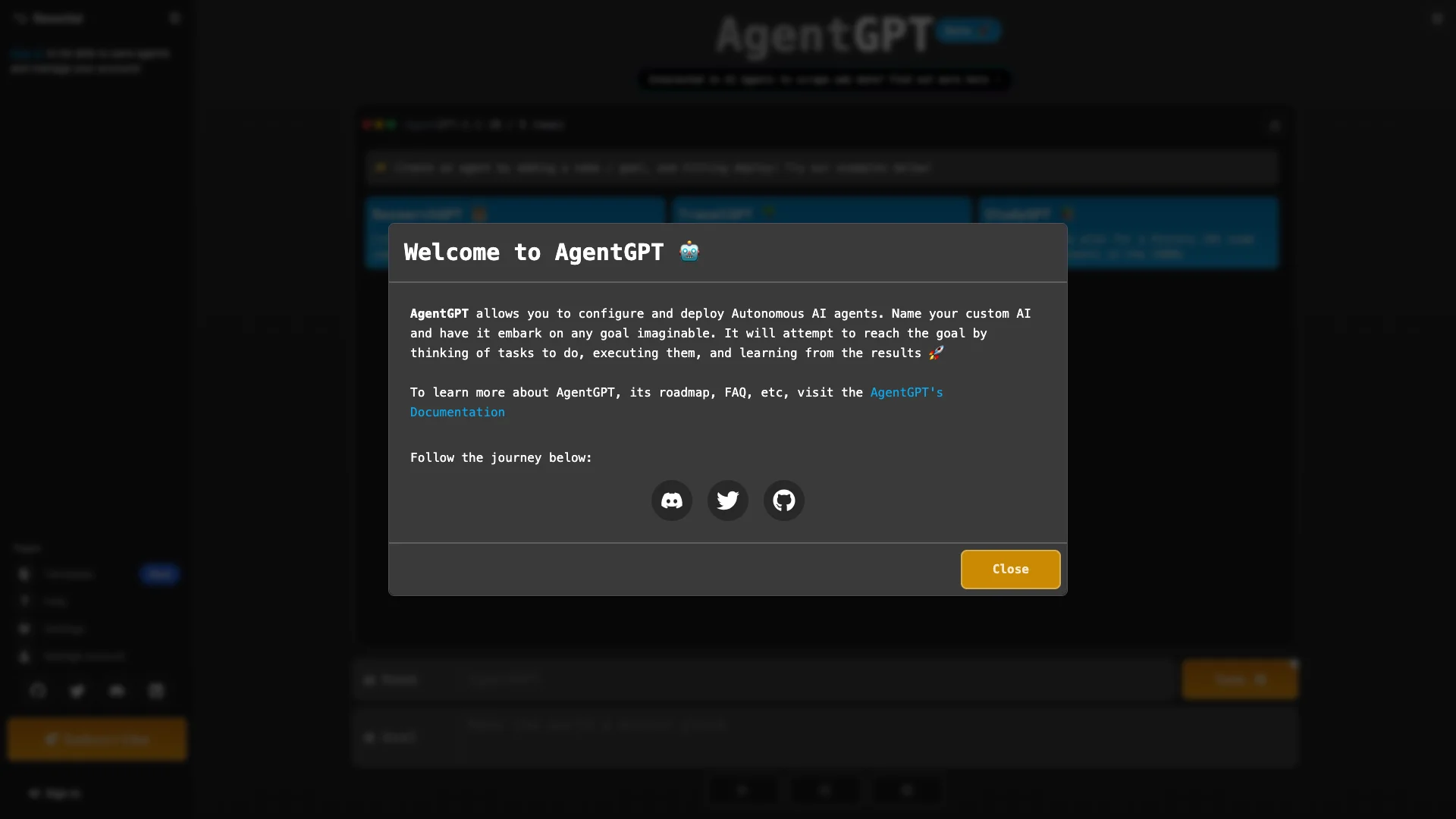
AgentGPT helps you build AI agents that act on their own to complete tasks. You simply give an agent a goal, like creating a research report or planning a trip, and it automatically breaks it down into steps and executes them to reach your desired outcome.

About AgentGPT

Who It's For

AgentGPT helps anyone automate tasks. Businesses, big or small, can use it for customer service, marketing, or research. You don't need to be a programmer for basic use. Technical users can also customize and deploy agents for more control.

What You Get

You get a smart AI agent that handles many tasks. It can do market research, plan trips, or assist with customer support. These agents work alone, breaking big goals into smaller steps. They can even use other tools and websites to complete jobs.

How It Works

To use AgentGPT, name your agent and give it a clear goal. The system then plans and performs all needed steps automatically. For example, tell it to "Plan a detailed trip to Hawaii." You can also adjust settings with an OpenAI API key for better performance. Just create an account, set your goal, and deploy.
Stay in the loop

Weekly roundup of new AI agents. No spam, unsubscribe anytime.

Subscribe and get the free 2026 AI Agents Field Guide

Join 1,500+ AI builders · weekly, no spam

Features & Capabilities

⚙️ AI Agent Core Functionality

Agent Creation & Deployment

Users can easily create and launch AI agents by defining a name and specific goal.

Goal-Driven Automation

Agents autonomously execute tasks and processes to achieve a user-defined objective.

Web Data Scraping

Specializes in leveraging AI agents for efficient and scalable extraction of data from the web.

💡 Guided Agent Experiences

Pre-configured Agent Templates

Offers ready-to-use agent templates for common tasks like research, travel planning, and study organization.

Goal-Based Examples

Provides practical examples illustrating how agents can tackle diverse objectives from comprehensive reports to detailed travel plans.

Use Cases

Automating Business Research & Competitive Intelligence

Businesses often struggle with the time-consuming process of gathering comprehensive market and competitor data. AgentGPT enables the deployment of autonomous agents to conduct in-depth research, perform scalable web scraping, and synthesize information into detailed reports, providing critical insights without extensive manual effort.

Market ResearchFor: Market Research Analysts

Streamlining Sales & Marketing Account Research

Sales and marketing professionals frequently spend valuable time on manual account research and lead qualification. AgentGPT empowers these teams to create agents that autonomously gather prospect data, identify key company insights, and support content generation for personalized outreach, accelerating the sales cycle and improving campaign effectiveness.

B2B SaaSFor: Account Executives

Autonomous Customer Support & Service Automation

Providing instant, accurate, and scalable customer support is a significant challenge for many businesses. AgentGPT allows for the creation of autonomous agents that can handle customer inquiries, provide rapid assistance, and integrate with existing systems, ensuring efficient and consistent service delivery around the clock.

Customer ServiceFor: Customer Service Managers

Personalized AI Assistant for Productivity

Individuals and professionals often need assistance with complex planning and organizational tasks, from travel itineraries to study schedules. AgentGPT acts as a personal AI assistant, enabling users to define a goal for which an agent will autonomously plan, research, and execute subtasks, significantly enhancing personal productivity.

General ProductivityFor: Professionals

Accelerating Content Generation & Creation

Content teams face pressure to produce high volumes of context-aware and engaging content efficiently. AgentGPT facilitates the autonomous generation of diverse content, from comprehensive reports to marketing copy, by researching topics and synthesizing information, thus speeding up content pipelines and maintaining brand voice.

MarketingFor: Content Marketers

Frequently asked questions

AgentGPT is an AI platform that enables the creation, configuration, and deployment of autonomous AI agents tailored to perform specific tasks by breaking down a given prompt into smaller subtasks and executing them sequentially to achieve a user-defined goal. It uses the OpenAI GPT-3.5 architecture and operates as a Natural Language Processing (NLP) system that generates human-like, context-aware text and actions.

AgentGPT can automate complex workflows like research, fake news detection, travel planning, customer support, and market research by decomposing a goal into actionable tasks. It allows users to define agents via a name and a goal, then deploy these agents to work autonomously. Agents can learn from interactions, create task queues, and execute tasks in a goal-directed manner. Furthermore, it can integrate with various tools by accessing external APIs, navigating websites, working with data files, filling forms, and performing spreadsheet edits during task execution. Its real-world applications include customer support automation, content generation, decision support, and personal assistance.

Users provide an Agent Name and a Goal or Objective. The system then autonomously plans, queues, and executes subtasks to achieve the overall goal. It can be configured with advanced settings via an OpenAI API key to fine-tune agent behavior such as focus level, token limits, and loop iterations for better performance.

AgentGPT can be used by businesses of all sizes, from startups to large enterprises, across industries including customer service, marketing, sales, and research. Non-technical users can also use it as basic use requires no programming skills, while advanced customization is available for technical users. Furthermore, developers and organizations can deploy it on local machines or use cloud platforms for more control and scalability.

Yes, users can customize the agent identity (name and mission), task focus (broad or narrowed), and performance parameters (loop iterations, token limits). They can also upgrade from free or beta versions to Pro versions for enhanced capabilities.

AgentGPT is currently in beta with ongoing community development. Some features may require paid subscriptions or API usage, for example, from OpenAI for GPT access. Different plans and pricing tiers exist, including Pro versions with enhanced features and support.

Unlike basic ChatGPT models that mainly answer questions, AgentGPT acts autonomously to execute complex, multi-step goals without constant user input. It is browser-based and doesn’t require complex local setups, making it more accessible than some alternatives like AutoGPT which may require technical skills. Additionally, it offers scalable web scraping and data analysis automation, which is distinct from standard chatbot functionalities.

Specific information on safeguards in AgentGPT (as distinct from OpenAI’s ChatGPT Agent) is limited. However, platforms like OpenAI’s ChatGPT Agent include real-time monitoring, prompt classification, and disabled memory features to prevent misuse. Users should consult individual platform policies for detailed compliance and safety measures.

To start using AgentGPT, create an account on supported platforms such as reworkd.ai. Then, define your agent’s name and goal, and deploy the agent, which will begin task identification and autonomous execution. Optionally, you can improve the agent with example prompts and advanced configuration.

AgentGPT can connect to APIs and external data sources for enhanced task execution, enabling integration into existing workflows, particularly for business applications like customer service or market research.

AgentGPT serves diverse sectors including customer service, providing instant and accurate support, business research and competitive intelligence, content creation, sales and marketing automation, and personal productivity and assistant tasks.

Tags