Course
Give your AI a permanent memory of your business. A course for people who use ChatGPT or Claude daily.Compound Context
KaibanJS logo

KaibanJS

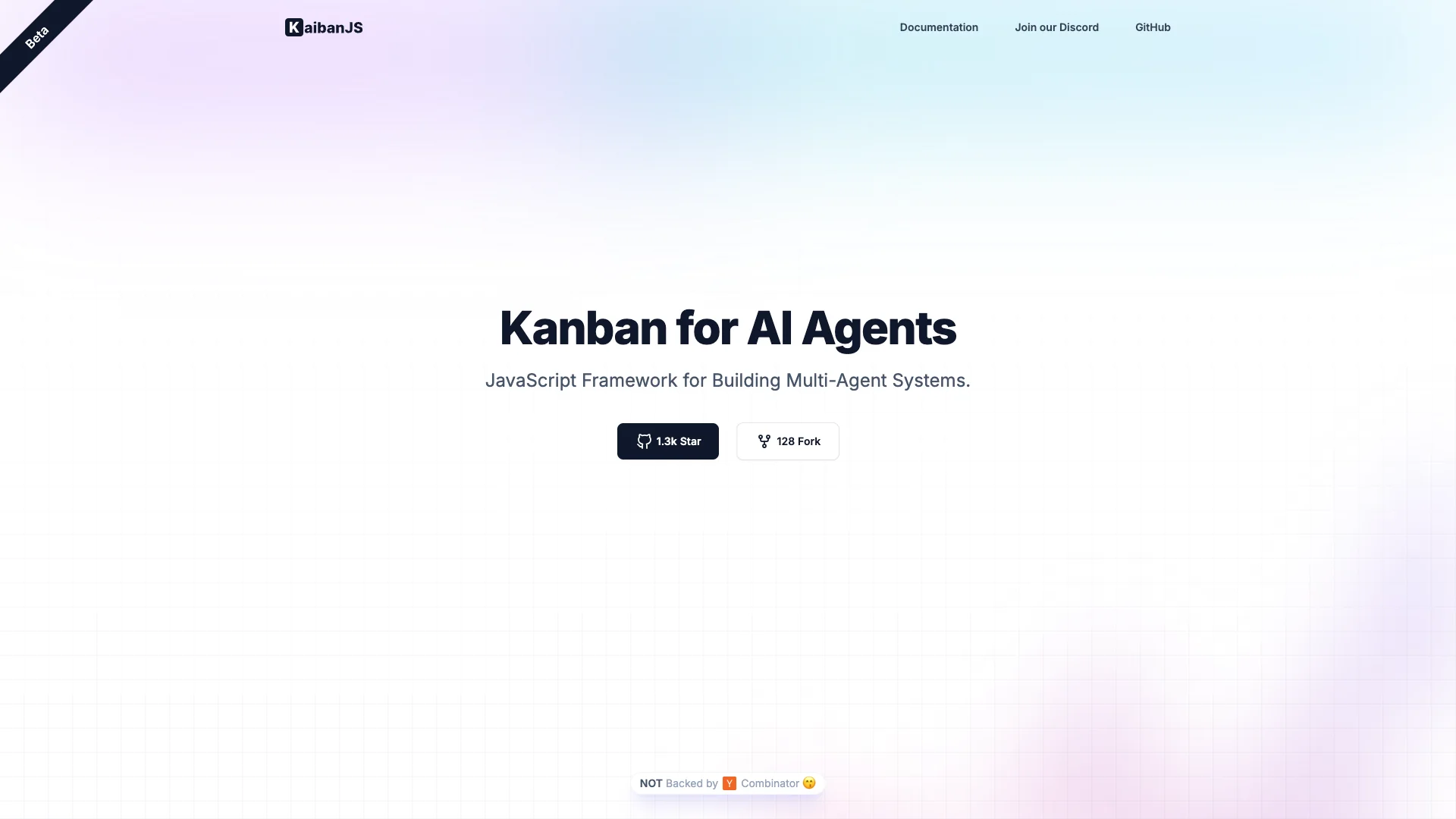
KaibanJS is an open-source JavaScript framework for building and managing teams of AI agents. It offers a visual board, like Trello, to watch agents collaborate on tasks. Easily integrate it into your existing JavaScript projects, gain full control, and avoid vendor lock-in.

About KaibanJS

Who It's For

KaibanJS is for JavaScript developers and teams wanting to easily add AI agents to their projects. It's perfect for building multi-agent AI systems for things like automation or content creation. If you need a clear, visual way to manage AI workflows and want full control without vendor lock-in, this tool is for you.

What You Get

You can create teams of specialized AI agents and set up how they work together on tasks. A visual Kaiban Board lets you see agent activity and progress in real-time. It connects with external tools and various AI models. It also works with popular JavaScript frameworks, allowing flexible deployment and complete ownership of your AI projects.

How It Works

First, set up KaibanJS. Then, define your AI agents with specific roles, goals, and even different AI models. Agents can use tools, like web search, for specialized tasks. A smart system manages how agents interact. You can track every step, cost, and status update on the Kaiban Board for full transparency and control.
Stay in the loop

Weekly roundup of new AI agents. No spam, unsubscribe anytime.

Subscribe and get the free 2026 AI Agents Field Guide

Join 1,500+ AI builders ยท weekly, no spam

Features & Capabilities

โš™๏ธ Core Agent Orchestration

Agent Specialization

Configure AI agents with distinct roles and goals to excel in specialized tasks and functions.

Multi-Agent Systems

Build and manage collaborative teams of AI agents to tackle complex problems efficiently.

Workflow Visualization

Utilize a familiar Kanban-style interface (Kaiban Board) to visualize, manage, and share AI agent workflows.

AI Lifecycle Management

Manage every step of the AI journey, from creating agents and visualizing workflows to integrating with deployment platforms.

๐Ÿ”— Ecosystem Integration

Tool Integration

Enable AI agents to utilize specialized tools like search engines and calculators for enhanced precision and efficiency.

Multiple LLM Support

Integrate and optimize a range of specialized AI models from diverse providers tailored to project aspects.

LangchainJS Compatibility

Support all LangchainJS-compatible tools, offering a versatile approach to tool integration.

Modern Framework Compatibility

Easily add AI capabilities to existing JavaScript projects built with NextJS, React, Vue, Angular, and Node.js.

โ˜๏ธ Deployment & Ownership

Local Development & Iteration

Run the Kaiban Board locally for rapid development, testing, and iteration of AI agent systems.

Flexible Deployment Options

Deploy AI agents anywhere, including private servers or cloud platforms like Vercel and AWS.

No Vendor Lock-in

Maintain complete control over AI projects and deployment without reliance on specific vendors or SaaS platforms.

Complete Project Ownership

Users retain full ownership of their AI projects, data, and infrastructure.

๐Ÿ“Š Observability & Control

Real-time Observability

Track every state change with detailed stats and logs, ensuring full transparency and control over agent operations.

Cost & Usage Monitoring

Gain real-time insights into token usage, operational costs, and LLM usage statistics for informed decision-making.

Redux-Inspired State Management

Utilize a unified, consistent state management architecture for AI agents, tasks, and overall workflow within applications.

Task Status Tracking

Monitor the status of individual tasks within agent workflows, providing clear visibility into progress and execution.

Use Cases

Automating Multi-Stage Content Creation & Research

Businesses struggle to produce high-quality, data-rich content efficiently across various domains. KaibanJS enables teams to build and orchestrate specialized AI agents that collaborate through iterative workflows, performing tasks like web research, drafting, and revision, much like human teams, to generate detailed articles, personalized itineraries, or tailored resumes.

Content Marketing, Publishing, Travel & Hospitality, HR Tech, B2B SaaSFor: Content Managers, Marketing Teams, Software Developers, Research Analysts

Seamless AI Agent Integration for JavaScript Developers

JavaScript development teams often face challenges integrating advanced AI capabilities into their existing web and backend applications without introducing new language stacks or vendor dependencies. KaibanJS provides a native JavaScript framework, enabling developers to easily build, integrate, and manage multi-agent AI systems directly within their NextJS, React, Vue, Angular, or Node.js projects, complete with a visual Kanban-style interface and full deployment control.

Software Development, B2B SaaS, Web DevelopmentFor: JavaScript Developers, Frontend Developers, Full-stack Developers, Software Architects

Optimizing Business Processes with Specialized AI Agent Workflows

Organizations seek to automate complex, data-driven business processes beyond simple RPA, requiring intelligent decision-making and tool utilization. KaibanJS allows the creation and orchestration of specialized AI agents, each designed for distinct tasks and integrated with external tools like web scrapers and APIs, to automate workflows, extract data, and refine outputs iteratively, all while providing real-time observability of performance and costs.

Enterprise Software, Data Analytics, Business Process Automation, IT OperationsFor: Solution Architects, Data Engineers, Operations Managers, Software Developers, DevOps Engineers

Frequently asked questions

KaibanJS is an open-source, JavaScript-native framework that enables developers to create, manage, and orchestrate teams of specialized AI agents. It allows for the creation of complex, collaborative workflows where multiple agents work together to complete tasks.

KaibanJS is designed for JavaScript developers looking to integrate AI agents into their projects, for teams building multi-agent AI systems for automation, research, content generation, and more, and for developers who want a simple, visual, and real-time way to manage AI workflows.

The main features of KaibanJS include Multi-Agent Orchestration, allowing the creation of teams of specialized agents with distinct roles; Task Workflows to define and coordinate workflows that pass tasks and results between agents; Real-Time Monitoring to visualize agent collaboration and workflow progress in real time; Tool Integration for easily connecting agents to external APIs and services; Framework Agnostic integration with NextJS, React, Vue, Angular, and Node.js; and a Human-Friendly API designed for simplicity and ease of use.

To get started with KaibanJS, first ensure you have the prerequisites: Node.js (v14 or later) and npm (v6 or later), along with an API key for OpenAI, Anthropic, Google AI, or another supported AI service. For installation, run npx kaibanjs@latest init, which sets up KaibanJS in your project and opens the Kaiban Board in your browser. Next, set up your API key by creating or editing a .env file in your project root and adding your API key (e.g., VITE_OPENAI_API_KEY=your-api-key-here). Finally, start the Kaiban Board by running npm run kaiban to manage agents, tasks, and workflows in the browser.

The core concepts in KaibanJS include Agents, which are autonomous entities with specific roles and goals; Tasks, defined as actions assigned to agents with defined inputs and outputs; a Team, which coordinates agents and tasks, managing the flow of information; and Tools, which are specialized utilities (like web scraping or data transformation) that agents can use.

Yes. KaibanJS allows you to define custom agent roles and goals, create complex task workflows with result passing, integrate external tools and APIs, and modify and extend workflows as needed.

KaibanJS provides a real-time dashboard (Kaiban Board) where you can monitor agent activity and task progress, view logs and outputs as workflows run, and deploy and manage workflows online.

Yes. KaibanJS is open-source and free to use. You can find the source code and contribute on GitHub.

Documentation can be found at docs.kaibanjs.com, LLM-friendly docs at docs.kaibanjs.com/llms-full.txt, and community support is available by joining the KaibanJS Discord. For bug reports and feature requests, GitHub Issues can be used.

Yes. KaibanJS is designed to fit into your current workflow. You can import and use it in NextJS, React, Vue, Angular, and Node.js projects with minimal setup.

KaibanJS supports a range of tools, including web scraping (e.g., Jina URL to Markdown Tool), data transformation, API integrations, and custom tools for specific use cases. Tools can be installed with: npm install @kaibanjs/tools.

After setting up your workflow, you can deploy your Kaiban Board online using platforms like Vercel. The Kaiban Board allows you to manage and monitor workflows in production.

Yes. Check out the official quick start guide on YouTube.

Yes. KaibanJS includes tools like the Jina URL to Markdown Tool, which simplifies web scraping and prepares data for AI workflows.

To contribute to KaibanJS, you can fork the repository on GitHub, submit pull requests and issues, and join the community on Discord to discuss ideas and improvements.

Tags

Specifications

Deployment
Browser
API
Self-hosted
Target Audience
Individual
Startup
Business
Complexity
Developer

Integrations

Trello
Jira
LangchainJS
Tavily Search Results
Google
Anthropic

Want your AI tool listed here?

Start with a free eligibility check.

Submit