Course
Give your AI a permanent memory of your business. A course for people who use ChatGPT or Claude daily.Compound Context
CAMEL logo

CAMEL

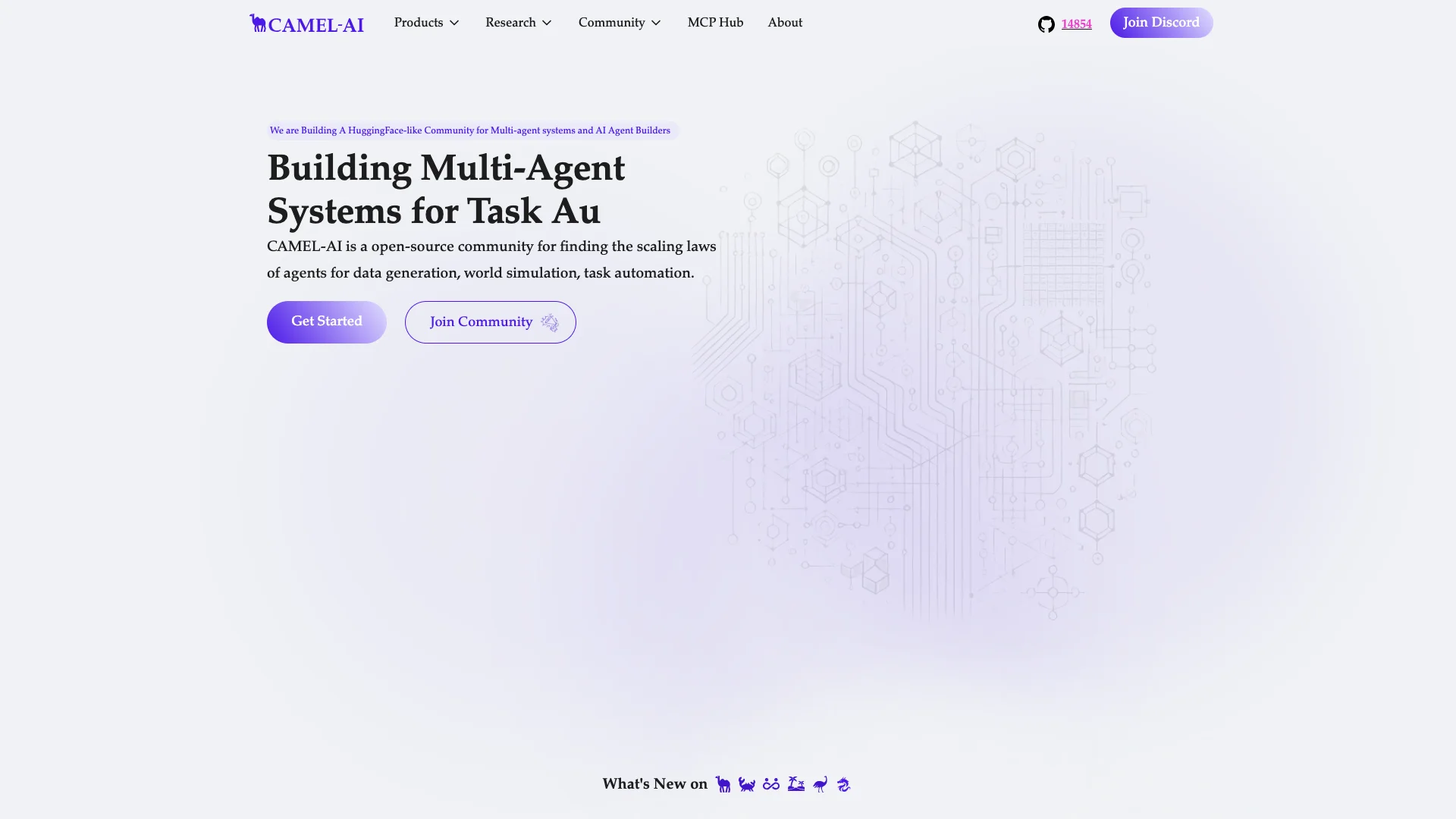
CAMEL-AI is an open-source framework for building advanced AI agent teams. It lets these AI teams work together to generate data, automate complex tasks, and simulate real-world social interactions. Designed for builders and researchers, it makes it easier to understand and scale powerful multi-agent systems effectively.

About CAMEL

Who It's For

CAMEL-AI is built for AI agent builders, researchers, and development teams. If you want to create and understand how multiple AI agents can work together, this tool is for you. It also helps businesses automate complex workflows and organizations pushing the boundaries of AI research.

What You Get

With CAMEL-AI, you get a powerful open-source framework that enables AI teams. You can generate various types of data, automate tasks, and simulate real-world environments like social media. It offers specialized tools for building AI agents, connecting them to different language models, and managing their collaboration.

How It Works

CAMEL-AI uses a system where AI agents are given roles and work together, sharing information like a team. It uses "Societies" to help agents coordinate tasks. The framework includes modules for generating data, running tasks automatically, and simulating large social interactions, helping you explore how AI scales effectively.
Stay in the loop

Weekly roundup of new AI agents. No spam, unsubscribe anytime.

Subscribe and get the free 2026 AI Agents Field Guide

Join 1,500+ AI builders · weekly, no spam

Features & Capabilities

⚙️ Core Agentic Capabilities

Multi-Agent Workforce Deployment

Build, manage, and deploy custom AI workforces to automate complex workflows and tasks.

Cooperative Agent Framework

Utilize a unique role-playing framework for agents to collaborate effectively and overcome common interaction challenges.

Retrieval-Augmented Generation (RAG) Pipeline

Enhance AI responses by integrating information retrieval from external sources, ensuring accuracy and contextual relevance.

Flexible Agent Components

Access a variety of single-agent types like Chat, Critic, Deductive Reasoner, and Search agents for specialized tasks.

✍️ Advanced Data Generation

Chain-of-Thought (CoT) Data Generation

Generate high-quality reasoning paths and detailed logical sequences through interactive chat agent dialogues.

Self-Instruct Instruction Generation

Create diverse and high-quality machine-generated instructions for tasks by combining human-written seeds and AI inputs.

Multi-Hop Question-Answer Generation

Systematically produce complex, multi-hop question-answer pairs from source text, with configurable complexity.

Self-Improving CoT Data Generation

Iteratively enhance and refine reasoning traces for problem-solving tasks through continuous self-evaluation and feedback.

🌎 Simulation & Benchmarking

Scalable Social Interaction Simulation (OASIS)

Simulate behavior of up to one million users on social media platforms to study complex social phenomena.

Social Media Simulation Platform (Matrix)

Blend real-time trending posts with precise user agent behavior to simulate digital social dynamics for A/B testing and feedback.

Cross-Environment Agent Benchmarking (CRAB)

Provide a comprehensive benchmark for evaluating multimodal language model agents across diverse environments and scenarios.

🔗 Ecosystem & Integrations

Broad LLM Model Support

Integrate with a wide range of large language models from leading providers such as OpenAI, Anthropic, Gemini, and Mistral AI.

Tool Integration Platform (Composio)

Manage and integrate various external tools with LLMs and AI agents using function calling for enhanced capabilities.

Vector Database Integration

Power next-generation AI applications with high-performance vector search databases for efficient similarity searches and data retrieval.

Use Cases

Automating Advanced Synthetic Data Generation

Training robust LLMs and chatbots demands high-quality, diverse data, which is often expensive and time-consuming to acquire manually. CAMEL-AI's specialized data generation modules like Chain-of-Thought and Self-Instruct allow users to automatically create vast amounts of synthetic conversational data, multi-hop Q&A pairs, and complex reasoning paths at scale, significantly reducing development costs and time.

AI/ML DevelopmentFor: AI/ML Engineers

Simulating Large-Scale Social & Market Dynamics

Understanding complex social phenomena, information spread, or user behavior on digital platforms is challenging and costly to study in real-world scenarios. CAMEL-AI, through its OASIS and Matrix platforms, enables the simulation of up to one million AI agents mimicking human-like interactions on social media, providing a safe and controlled environment for researchers and marketers to test hypotheses, analyze trends, and simulate user feedback.

Social Science ResearchFor: Market Researchers

Orchestrating Complex Enterprise Workflow Automation

Many intricate enterprise workflows involve multiple steps, decision points, and extensive information retrieval, making them difficult to automate with traditional single-agent AI solutions. CAMEL-AI provides a multi-agent workforce framework that allows agents to collaboratively assign roles, delegate tasks, and leverage RAG pipelines for accurate and contextually relevant data, transforming complex business processes into efficient automated tasks.

Enterprise SoftwareFor: Business Process Engineers

Developing & Benchmarking Next-Gen AI Agents

Developing, testing, and rigorously evaluating new AI agents and multi-agent systems, especially across diverse operating environments, demands specialized tools and robust benchmarks. CAMEL-AI offers a comprehensive open-source framework for AI agent builders, providing components like CRAB for cross-environment benchmarking and OWL for optimizing multi-agent task automation, empowering developers and researchers to systematically improve their agent designs and performance.

AI Research & DevelopmentFor: AI Engineers

Frequently asked questions

CAMEL-AI is an open-source community and framework designed for building multi-agent systems. It stands for "Collaborative AI Agents Multi-Agent Framework" and is specifically designed to be data-driven, stateful, and agent-friendly. The platform focuses on finding the scaling laws of agents for data generation, world simulation, and task automation.

To use CAMEL-AI, you'll need Python 3.8 or higher as the foundation. A code editor like VS Code, PyCharm, or any text editor will work for development purposes.

The installation process is straightforward: create a virtual environment and run pip install camel-ai. After installation, set your model provider API keys and you're ready to begin.

CAMEL-AI agents are built with several key components that set them apart: a System Message that defines the agent's "personality" and role, a Chat Interface that enables communication between agents or with users, and Memory that allows agents to retain information and improve over time.

CAMEL-AI provides comprehensive functionality through multiple core modules: Agents for building AI systems, Models for interfacing with various language providers (OpenAI, Anthropic, Google), Messages for agent communication, Prompts with pre-built templates, and Toolkits that extend capabilities with web search, file operations, and APIs. The framework also includes specialized components like Data Generation, Embeddings, RAG pipelines, and World Simulation environments.

Rather than competing, agents in CAMEL-AI collaborate and share information like a well-oiled team. The framework includes Societies as coordinator layers that assign roles, delegate tasks, and manage collaboration between multiple agents.

Multi-agent setups in CAMEL-AI are powerful tools for real-world impact. Researchers use them to solve complex problems, generate synthetic data for experiments, automate workflows, and explore how AI scales at larger levels. The framework enables large-scale social simulations through environments like OASIS, which can model Reddit, Twitter, and user interactions.

The framework is designed to handle scaling effectively—you can add more agents and they continue to work harmoniously together, making it perfect for large projects.

Retrieval-Augmented Generation (RAG) combines retrieval and generation methods to provide agents with enhanced accuracy, up-to-date knowledge, and improved generalization. CAMEL-AI offers both customized RAG and Auto RAG pipelines. The Auto RAG uses AutoRetriever with default settings that employ OpenAIEmbedding as the default embedding model and Milvus as the default vector storage.

CAMEL-AI includes Synthetic Data Engines that use self-instruct, Chain-of-Thought, and Source2Synth pipelines with verifiers. This capability is particularly valuable for creating training data for customer service agents and chatbots without needing extensive manual data collection.

CAMEL-AI includes several specialized components: OWL (Optimized Workforce Learning) for multi-agent automation of real-world tasks, CRAB Benchmark for cross-environment agent automation tasks across Ubuntu and Android platforms, and Project Loong for verifier-driven synthetic data generation.

You can build customized software using natural language ideas through LLM-powered multi-agent collaboration, create synthetic data for training purposes, automate complex workflows, generate domain-specific content like posters from papers, and simulate multi-agent environments for testing and research.

CAMEL-AI works with researchers, development teams, enterprises needing workflow automation, and organizations focused on AI research and development. The framework actively seeks talented individuals and teams interested in building or researching environments for LLM-based agents.

CAMEL-AI maintains an active open-source community with GitHub discussions where you can ask questions and contribute to development. The project is actively seeking collaboration through research partnerships and welcomes contributions from the community.

Comprehensive documentation is available through the official CAMEL-AI website, including tutorials on RAG implementation, agent tool usage, installation, and first steps. The GitHub repository also contains additional resources and community guidelines.

Tags

Specifications

Deployment
Browser
API
Self-hosted
Cloud
Target Audience
Individual
Startup
Business
Enterprise
Complexity
Expert

Integrations

Notion
GitHub
Eigent
EigentBot
Matrix
OASIS

Want your AI tool listed here?

Start with a free eligibility check.

Submit